

Scale requires an operating system that matches the complexity of the business.
Most companies grow faster than the systems that support them.
When definitions differ, workflows drift, and teams operate on incompatible logic, performance becomes unpredictable.
Scale.OS is the unified architecture that creates clarity, consistency, and operational precision across the entire business.
Companies hit a ceiling because their internal systems remain fragmented.
Scaling businesses consistently experience the same structural failures:
1. Fragmented Logic
Teams interpret qualification, priority, and value differently.
This produces inconsistent execution and unreliable signals.
4. Unstandardised Definitions
Terms like “opportunity,” “commit,” “risk,” or even “done” vary across teams.
Misalignment compounds with scale.
WHAT SCALE.OS PROVIDES
A unified architecture for clarity, execution, and cross-functional coherence.
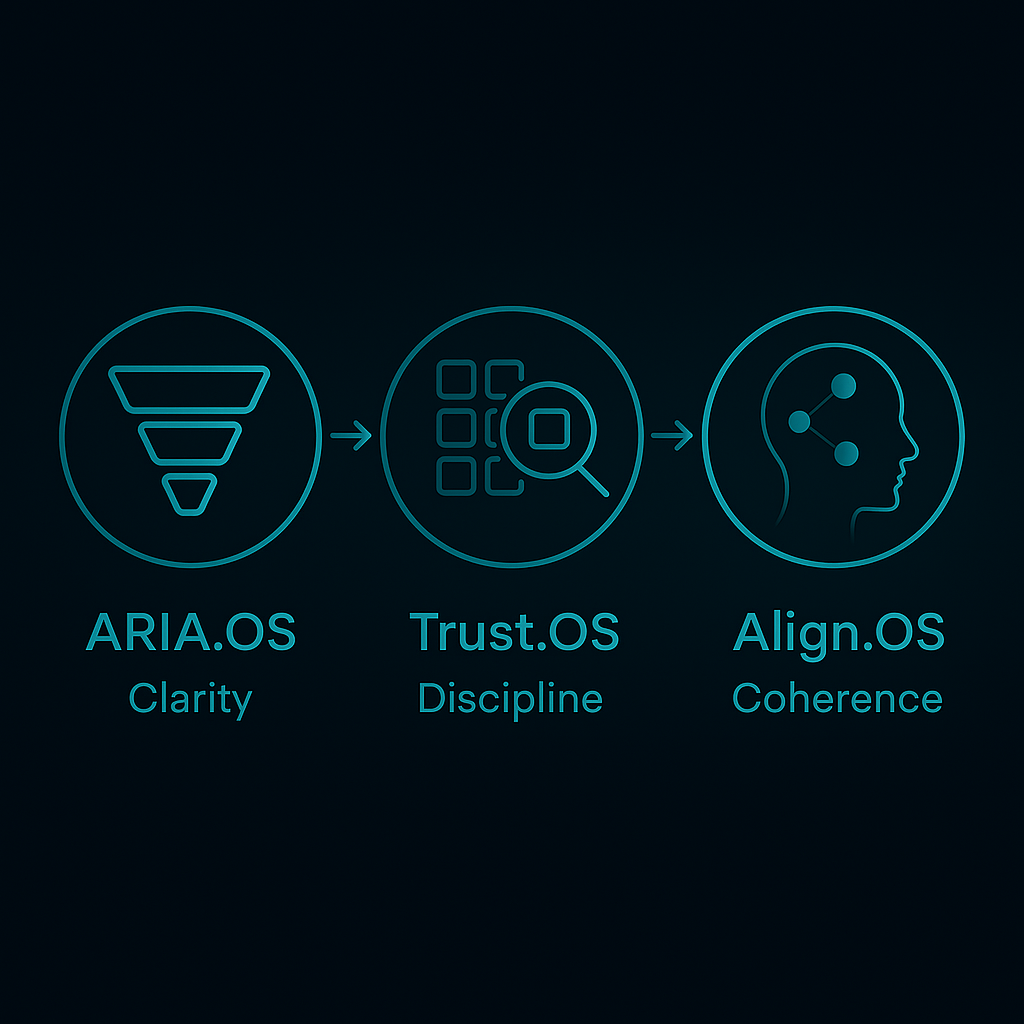
Scale.OS has three integrated engines, each solving a critical operating need:
ARIA.OS — Strategic Intelligence Engine
Trust.OS — Execution & Accountability Engine
Align.OS — Organisational Coherence Engine
Together, they replace fragmented processes with a cohesive, evidence-based operating system.
2. Divergent Workflows
Marketing, Sales, CS, and Product run processes that don’t connect.
Handoffs create friction instead of flow.
5. No Unified OS
Tools are added, dashboards multiply, but the underlying logic remains inconsistent.
This creates operational drift and performance variability.
Scale.OS resolves these structural constraints by introducing a single, company-wide operating system.
TRUST.OS — EXECUTION & ACCOUNTABILITY ENGINE
Purpose:
Install an evidence-based operating rhythm that drives predictable performance.
Core Functions:
Evidence-based commit categories
Standardised deal stages
Weekly operating cadence
Monthly alignment reviews
Quarterly system calibration
Forecast governance and signal detection
Impact:
Forecast accuracy improves
Execution stabilizes
Variance reduces
Teams adopt consistent performance standards
THE OUTPUT: A COHESIVE, PREDICTABLE OPERATING SYSTEM
Scale.OS creates:
Unified definitions
Consistent execution
Reliable forecasting
Aligned workflows
Clear ownership
Lower operational friction
Faster cross-functional throughput
A single company-wide source of truth
This is how high-growth companies achieve operational consistency without increasing complexity.
3. Unstable Operating Rhythms
Teams update forecasts, metrics, and progress at different cadences.
The organisation loses coherence and predictability.
ARIA.OS — STRATEGIC INTELLIGENCE ENGINE
Purpose:
Standardize judgment, unify definitions, and provide consistent logic for decision-making.
Core Functions:
Codifies qualification and prioritisation logic
Creates shared definitions across GTM teams
Surfaces patterns and operational signals
Provides clarity frameworks for pipeline quality
Ensures consistent interpretation of data and opportunities
Impact:
Higher pipeline integrity
Reduced interpretational drift
Faster, clearer decision-making
Lower dependency on individual judgment
HOW SCALE.OS WORKS
A structured installation process that converts system logic into company-wide execution.
STEP 1 — Architecture Mapping
Map definitions, workflows, rhythm gaps, and signal inconsistencies.
STEP 2 — OS Configuration
Codify logic, definitions, and operating expectations across teams.
STEP 3 — System Integration
Deploy the operating system across workflows, cadences, and functional teams.
STEP 4 — Operational Enablement
Teams adopt the new logic, definitions, and rhythm in live execution.
STEP 5 — Review & Optimization
Quarterly recalibration to ensure the OS remains aligned with growth stage.